

US job growth surged in August, and the unemployment rate held steady, suggesting the labor market has more momentum than previously thought.
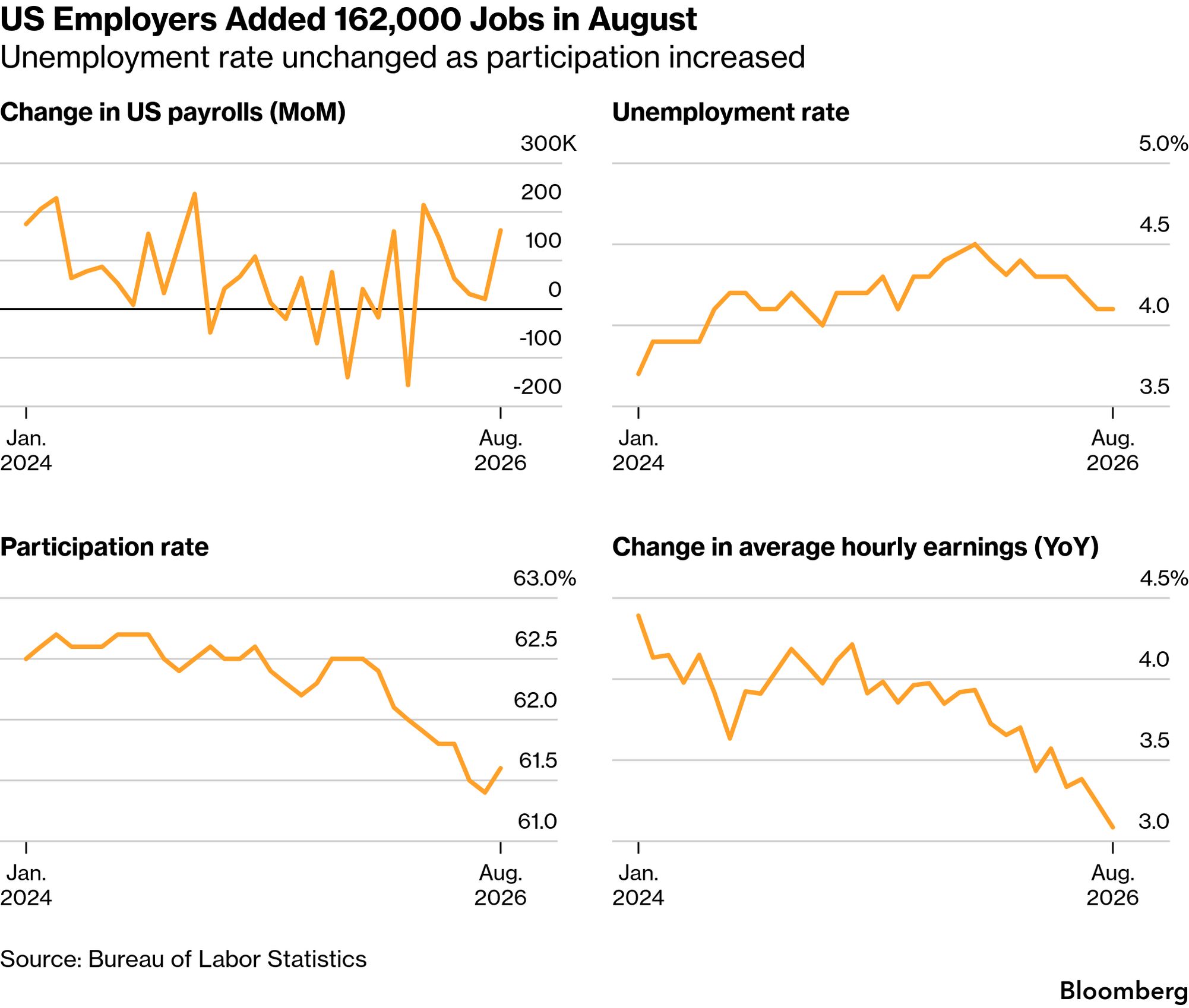
Nonfarm payrolls increased 162,000 last month, and July’s job losses were revised away, according to Bureau of Labor Statistics data out Friday. The August increase topped all estimates in a Bloomberg survey. The unemployment rate remained at 4.1%.
The report indicates the labor market is powering through uncertainty from the Iran war and pressure from inflation. Federal Reserve officials will likely read it as bolstering the argument for raising interest rates, though next week’s consumer price data will prove key to the central bank’s decision later this month.
“The labor market is showing signs of near-term cyclical strength, even as longer-term structural concerns remain,” said Adam Schickling, a senior economist at Vanguard. “This report is unlikely to materially change the Federal Reserve’s outlook on its own. The labor market remains resilient enough to keep the focus on inflation.”
Yields on 2-year Treasury notes rose, and the S&P 500 index fell as investors upped the odds of a rate increase at the Sept. 15-16 meeting.
The broad advance in payrolls was led by a rebound in leisure and hospitality employment following big declines in June and July. Local government education also added about 42,000 jobs following outsize cuts last month. That category can be volatile in the summer as many teachers fall off payrolls before returning again as the school year begins.
Manufacturing payrolls rose by the most since 2023, while construction firms added the most jobs since January. Many economists have pointed to the data-center buildout as a driver of demand for construction labor this year.
The financial activities and information sectors — both of which are seen as particularly exposed to AI-related job displacement — shed a combined 34,000 positions.
Following the release of the report, President Donald Trump weighed in Donald J. Trump: Great jobs number just announced, breaking all estimates (except mine!) by double and triple - And you, calling on the Fed to cut rates.
“The Fed Board, with its great new leader, must get smart - BE PATRIOTS for a change,” Trump said. “High interest rates put the U.S.A. at a very unfair disadvantage, and I won’t allow that to happen!”
“The strong August jobs report raises the risk of a Fed rate hike in September. It leaves the August CPI report (due Sept. 11) as the determining factor — and we expect that reading to be just borderline acceptable to the doves. The September FOMC meeting is shaping up to be a very close call.” — Anna Wong, Andrew Sacher and Eliza WingerTo read the full note, click US REACT: August Jobs Defy Historical Pattern on Seasonal Quirks
The participation rate — the share of the population that is working or looking for work — edged up to 61.6% in August, marking the first improvement in almost a year. The increase was concentrated among younger and older workers: Participation for those ages 25 to 54, also known as prime-age workers, was unchanged at 83.4%.
A decline in participation in 2026, partly reflecting an aging population and the Trump administration’s immigration crackdown, has helped keep the unemployment rate low.
Average hourly earnings rose 0.3% from July and 3.1% from a year earlier, the slowest since 2021. At the same time, an increase in average hours worked to the highest in more than two years helped lift weekly pay, which could support consumer spending in the months ahead.
Other data suggest the labor market remains in a low-hire, low-fire mode. Job openings edged higher in July, and layoffs fell, indicating demand for workers remains stable at a subdued level. ADP Research data showed US companies added jobs at a more moderate pace in August, indicating a slowdown in hiring momentum.
Fed Chairman Kevin Warsh, in a speech last week in Jackson Hole, Wyoming, said he saw the labor market as “quite stable” and “consistent with full employment.”
So many upbeat takes on today’s jobs report. I’m a lot more skeptical.
This is not a re-acceleration yet. It's a labor market that has touched the bottom and is no longer deteriorating.
Yes, employers added 162,000 jobs. Yes, June and July payrolls were revised up by a combined 55,000. Treasury yields climbed on the report. Markets increased the odds of a September Fed hike.
But nearly two-thirds of August’s job growth came from just two places: food services and local government education.
Restaurants added 59,000 jobs. Local government education added 42,000 — a jump that largely reversed July’s decline and looks more like a school-calendar seasonal-adjustment wrinkle than a hiring wave.
There are enough quirks in this report to stay cautious. And it’s still very hard to find a job.
The number of people unemployed for 27 weeks or longer rebounded by 159,000 to 1.9 million, while median unemployment duration climbed to 11.4 weeks — up from 10.5 last month and 9.9 a year ago.
Wage growth is steady, not accelerating. And with wages up 3.1% over the year while inflation is running faster, real wages are still falling.
So yes, the labor market looks more stable than it did a month ago. But stable doesn’t mean strong.