

Starbucks will pay about $35 million to more than 15,000 New York City workers to settle claims it denied them stable schedules and arbitrarily cut their hours, city officials announced Monday.
The company will also pay $3.4 million in civil penalties under the agreement with the city’s Department of Consumer and Worker Protection. It also agrees to comply with the city’s Fair Workweek law going forward.
A company spokeswoman said Starbucks is committed to operating responsibly and in compliance with all applicable local laws and regulations in every market where it does business, but also noted the complexities of the city’s law.
“This (law) is notoriously challenging to manage and this isn’t just Starbucks issue, nearly every retailer in the city faces these roadblocks,” spokeswoman Jaci Anderson said.
Most of the affected employees who held hourly positions will receive $50 for each week worked from July 2021 through July 2024, the department said. Workers who experienced a violation after that may be eligible for compensation by filing a complaint with the department.
The $38.9 million settlement also guarantees employees laid off during recent store closings in the city will get the chance for reinstatement at other company locations.
The city began investigating in 2022 after receiving dozens of worker complaints against several Starbucks locations, and eventually expanded its investigation to the hundreds of stores in the city. The probe found that most Starbucks employees never got regular schedules and the company routinely reduced employees’ hours by more than 15%, making it difficult for staffers to know their regular weekly earnings and plan other commitments, such as child care, education, or other jobs.
The company also routinely denied workers the chance to pick up extra shifts, leaving them involuntarily in part-time status, according to the city.
The agreement with New York comes as Starbucks’ union continues a nationwide strike at dozens of locations that began last month. The number of affected stores and the strike’s impact remain in dispute between the two sides.
From corporate executives to Wall Street analysts to Federal Reserve officials, references to the “K-shaped economy” are rapidly proliferating.
So what does it mean? Simply put, the upper part of the K refers to higher-income Americans seeing their incomes and wealth rise, while the bottom part points to lower-income households struggling with weaker income gains and steep prices.
A big reason the term is popping up so often is that it helps explain an unusually muddy and convoluted period for the U.S. economy. Growth appears solid, yet hiring is sluggish, and the unemployment rate has ticked up. Overall, consumer spending is still rising, but Americans are less confident. AI-related data center construction is soaring while factories are laying off workers and home sales are weak. And the stock market still hovers near record highs even as wage growth is slowing.
It also captures ongoing concerns around affordability, which is much more of a concern for middle and lower-income households. Persistent inflation has received renewed political attention after voter anger over costly rents, groceries, and imported goods helped Democrats win several high-profile elections last month.
“Those at the bottom are living with the cumulative impacts of price inflation,” said Peter Atwater, an economics professor at William & Mary in Virginia. “At the same time, those at the top are benefiting from the cumulative impact of asset inflation.”
Here are some things to know about the K-shaped economy:
Not an L, U, or V
Atwater actually popularized the label “K-shaped economy” during the pandemic after seeing it crop up on social media. Other economists were discussing different letters to describe how the COVID recession in 2020 could play out: Would it be a V-shaped recovery, meaning a sharp decline and then rapid bounce-back? Or would it be U-shaped, meaning a more gradual rebound? Or, worse, L-shaped: A recession followed by extended stagnation.
“There was sort of this land-grab for letters,” Atwater said. “To me, the letter that made the most sense was K.”
Back then, it captured the differing fortunes between white-collar professionals still employed and working at home while stock prices rose, even as massive layoffs at factories, restaurants, and entertainment venues pushed unemployment to nearly 15%.
Inequality persists
Inequality was somewhat reversed in the aftermath of the pandemic, when businesses offered large raises for blue-collar workers as the economy reopened and demand surged. Many companies — restaurants, hotels, entertainment venues — were caught short-staffed and sought to rapidly increase hiring. Lower-income workers saw larger pay gains than higher-paid ones.
In 2023 and 2024, inflation-adjusted wages for the bottom quarter of workers rose at a yearly rate of 3.9%, outpacing the 3.1% gains for the top quarter, according to research by the Federal Reserve Bank of Minneapolis.
“We had that kind of two-year period where the bottom was catching up, and that talk of the K-shape went away,” Dario Perkins, an economist at TSLombard, said. “And since then, the economy’s cooled down again,” he added, bringing back K-shape references.
This year, however, inflation-adjusted wage growth has weakened as hiring has fallen, with the drop more pronounced for lower-income Americans. Their wage growth has plunged to an annual rate of just 1.5%, the Minneapolis Fed found, below that of the highest earning quarter of workers at 2.4%.
Slower income growth has left many lower-income workers less able to spend. Based on data from its credit card and debit card customers, the Bank of America Institute found that spending among higher-income households rose 2.7% in October compared with a year ago, while lower-income groups lagged at just 0.7%.
And a Federal Reserve Bank of Boston study in August found that consumer spending in recent years has been driven by richer households, while lower- and middle-income Americans have piled up more credit card debt even as they’ve spent less.
Businesses take note
Corporate executives are paying attention and in some cases explicitly adjusting their businesses to account for it. They are seeking ways to sell more high-priced items to the wealthy while also reducing package sizes and taking other steps to target struggling consumers.
Henrique Braun, chief operating officer at Coca-Cola, for example, said in late October that the company is pursuing both “affordability” and “premiumization.” It is generating more of its earnings from higher-end products such as its Smartwater and Fairlife filtered milk brands, while at the same time introducing mini cans for those looking to spend less.
“We continue to see divergence in spending between the income groups,” Braun said in a conference call with analysts last month. “The pressure on middle and low-end income consumers is still there.”
Sales of first- and business-class tickets have been fueling revenue and profit for Delta Air Lines, its CEO Ed Bastian said in October, while lower-end consumers have been “clearly struggling.”
And Best Buy CEO Corie Barry on Tuesday said that the top 40% of all U.S. consumers are driving two-thirds of all consumption.
The remaining 60% are focused on getting the best deals and are more dependent on a healthy job market, she said.
“One of the things we’re watching closely is how employment continues to evolve, particularly for that cohort of people who are living more paycheck to paycheck,” she added.
The massive investment in data centers and computing power has also contributed to the K-shaped economy by lifting share prices for the so-called “Magnificent 7” companies competing to build out AI Infrastructure. Yet so far it’s not creating many jobs or lifting incomes for those who don’t own stocks.
“What we see at the very top is an economy that is sort of self-contained ... between AI, the stock market, the experiences of the wealthy,” Atwater said. “And it’s largely contained. It doesn’t flow through to the bottom.”
Driven by big gains for companies like Google, Amazon, Nvidia, and Microsoft, the stock market has risen nearly 15% this year. But the wealthiest 10% of Americans own roughly 87% of the stock market, according to Federal Reserve data. The poorest 50% own just 1.1%.
K-shape comes with concerns
Many economists worry that an economy propelled mostly by the wealthiest isn’t sustainable. Perkins notes that should layoffs worsen and unemployment rise, middle- and lower-income Americans could pull back sharply on spending. Revenue for companies like Apple and Amazon would fall. Advertising revenue, which is fueling companies such as Google and Facebook parent Meta, typically plunges in downturns.
Such a cycle could even force the “Mag 7” to pull back on their AI investments and send the economy into recession, he said.
“Then you’re talking about the bottom of the K essentially pulling down the top,” he added.
Perkins, however, sees a different path as more likely: Many U.S. households will receive larger tax refunds early next year under the Trump administration’s budget law. And Trump will likely appoint a new Federal Reserve chair by next May who will be more inclined to cut interest rates. Lower borrowing costs could accelerate growth and wages, though it could also worsen inflation.
Americans are paying more for food, for clothes, but cars? No thanks. Increasingly, consumers are buying used vehicles, waiting for deals, or taking on longer car loans in a bid to save cash, according to industry experts. Forecasters now expect "muted or no growth" in auto sales for both 2025 and 2026, driven by tariffs, inflation, and a tough job market. But there's one group that could keep the market afloat, if only for a limited time: the top 20% of American households, who continue to spend freely.
Coverage of the labor market in 2025 has taken on a decidedly white-collar tone, with artificial intelligence being cast as the principal long-term threat to the American workforce.
With the ability to write billions of lines of code daily and conduct other repetitive, cognitive tasks at scales and speeds humans could never challenge, such fears are not unfounded, and AI has already been cited in many of the mass reductions announced by Amazon and other corporations in recent weeks.
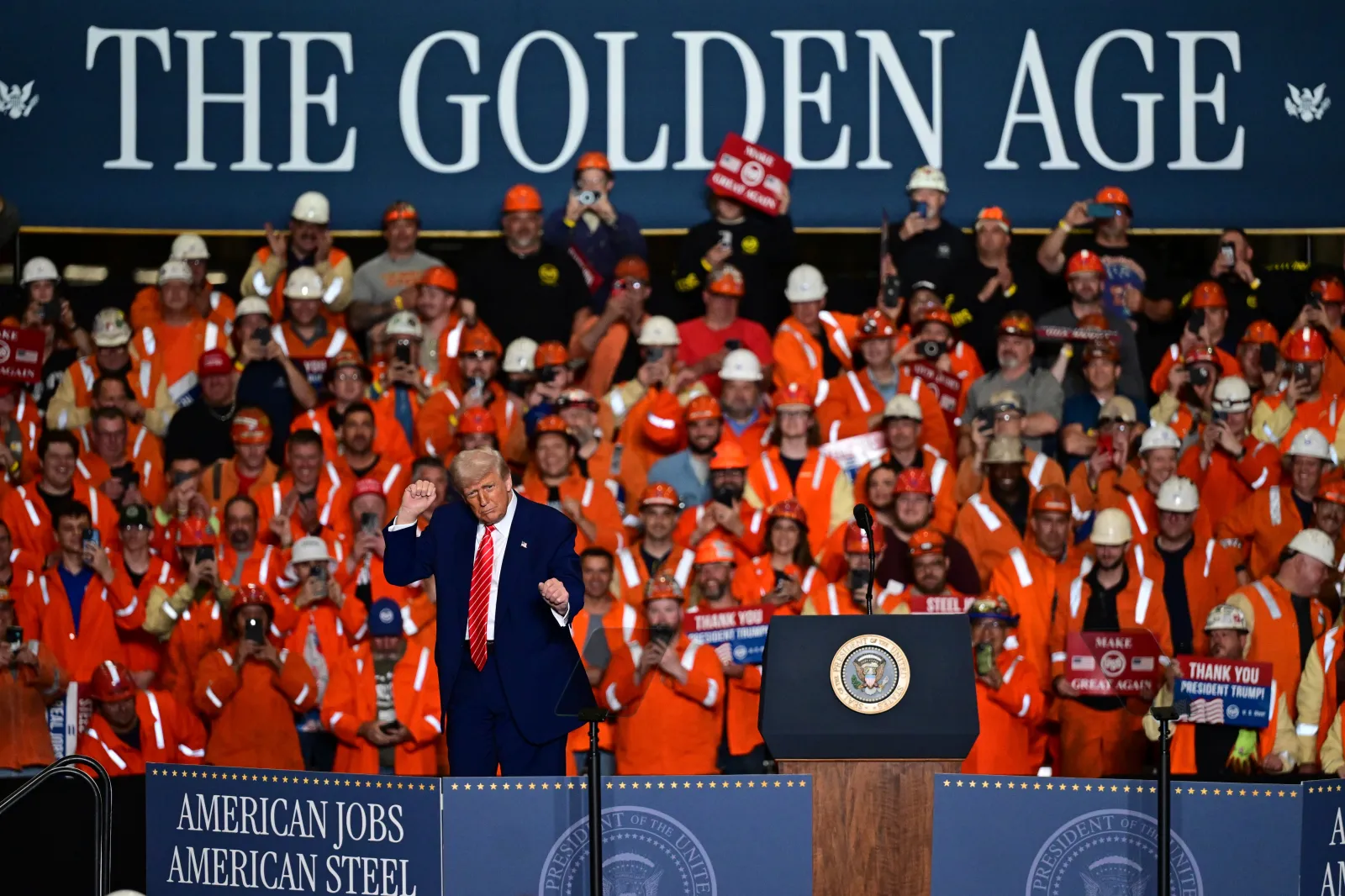
But for all the hand-wringing over the potentially ill-fated employees of Silicon Valley and Wall Street, a quieter crisis appears to be unfolding for the U.S.'s blue-collar employees, despite the pledges and efforts of the current administration to foster a renaissance in marquee industries such as construction and manufacturing.
"Reviving the blue-collar boom that Americans experienced during the first Trump term has been a day one priority for the administration," the White House told Newsweek, while citing improvements to real wages and manufacturing output in 2025.
The latest Labor Department data puts the issue of employment into sharp relief. September's delayed jobs report showed an encouraging uptick in overall hiring but no pause in blue-collar employment's long-term decline.
Of the five industry groups or "supersectors" that could be broadly considered "blue collar"—manufacturing, mining and logging, transportation and warehousing, utilities, and construction—only the latter saw an increase in September. Construction's 19,000-job gain was also insufficient to offset the monthly loss of 25,300 jobs in transportation or manufacturing, shedding a further 6,000.
Year-over-year changes show that annual payroll declines have accelerated since January—albeit continuing a long-term trend—and have pushed blue-collar job growth into negative territory for the first
Heidi Shierholz, the chief economist for the Department of Labor during President Barack Obama's tenure, told Newsweek there was undeniably a deterioration in employment conditions for the U.S.'s blue-collar workers.
"Between April and September, goods-producing industries (manufacturing, construction, logging, mining) lost 72,000 jobs, with most of those losses (58,000) in manufacturing," she said, adding that the services sector—which falls partially under the blue-collar umbrella—is "limping along" thanks solely to gains in health care.
David Dorn, a labor market expert at the University of Zurich, noted the sluggish-to-negative employment growth across several blue-collar sectors and particularly in construction.
"This sector is highly sensitive to broader economic deceleration," he told Newsweek, "and increasingly restrictive immigration policies under the current U.S. administration are likely constraining labor supply."
As for manufacturing, Dorn said it was "difficult to isolate" the direct effects of President Donald Trump's tariffs on employment, but he doubted whether these had "generated any sustained gains" in jobs.
To Dean Baker, a co-founder of the Center for Economic and Policy Research, tariffs have been largely to blame for the uncertainty and "overall weakness in demand" that has driven cautious hiring across blue-collar sectors.
"Companies are reluctant to invest in a context where they have no idea what tariffs will be in place six months from now, much less three to five years from now," he told Newsweek. "Also, tariffs pull money out of consumers' pockets, reducing demand."
While the data unveils a downgrade in hiring conditions for American blue-collar workers, taking a step back shows this to be an acceleration rather than a sudden free fall that began in 2025. Aside from the effects of Trump's policies—trade, immigration, or otherwise—exogenous factors from offshoring to automation seem destined to disrupt blue-collar work for the foreseeable future.
Economist Orley Ashenfelter noted one revelatory paradox: Despite declining employment in the sector, manufacturing output has risen this year—proof, he said, that productivity was improving even as fewer humans were on the factory floor.
"This change is probably inevitable. It is just too easy to mechanize in manufacturing," he said, adding that "those good old-school jobs are not coming back."
Baker said manufacturing's gradual decline as a share of total employment had "been the case for more than 50 years," as labor demand shifted toward health care, education, and other roles within the more service-focused economy.
"Trump is doing nothing to address these issues," Baker said, though he conceded, "It is not clear what he could do."